BlogGuides
AI for beauty salons: skin analysis, the real numbers
One click, and Google will show my articles more often in your results.
Two families of AI-assisted skin-analysis tools circulate in beauty salons today: professional cameras like VISIA from Canfield Scientific, and software like Perfect Corp's, used on a tablet or smartphone. Both have a published scientific study behind them, but in both cases the real finding is more modest than what the marketing material claims.
Two families of tools, two investment brackets
The first form is a dedicated camera like VISIA from Canfield Scientific, a tool historically used in cosmetic dermatology. Canfield doesn't publish a price list: the official product page tells buyers to contact an authorized distributor for a quote. The used-equipment market still gives a sense of the range: in November 2026, a US medical-equipment reseller had a used VISIA Gen.7 unit listed for $11,900, against an original list price of $20,664.86, while another dealer rents out the earlier VISIA-CR model starting at $354.04 a month.
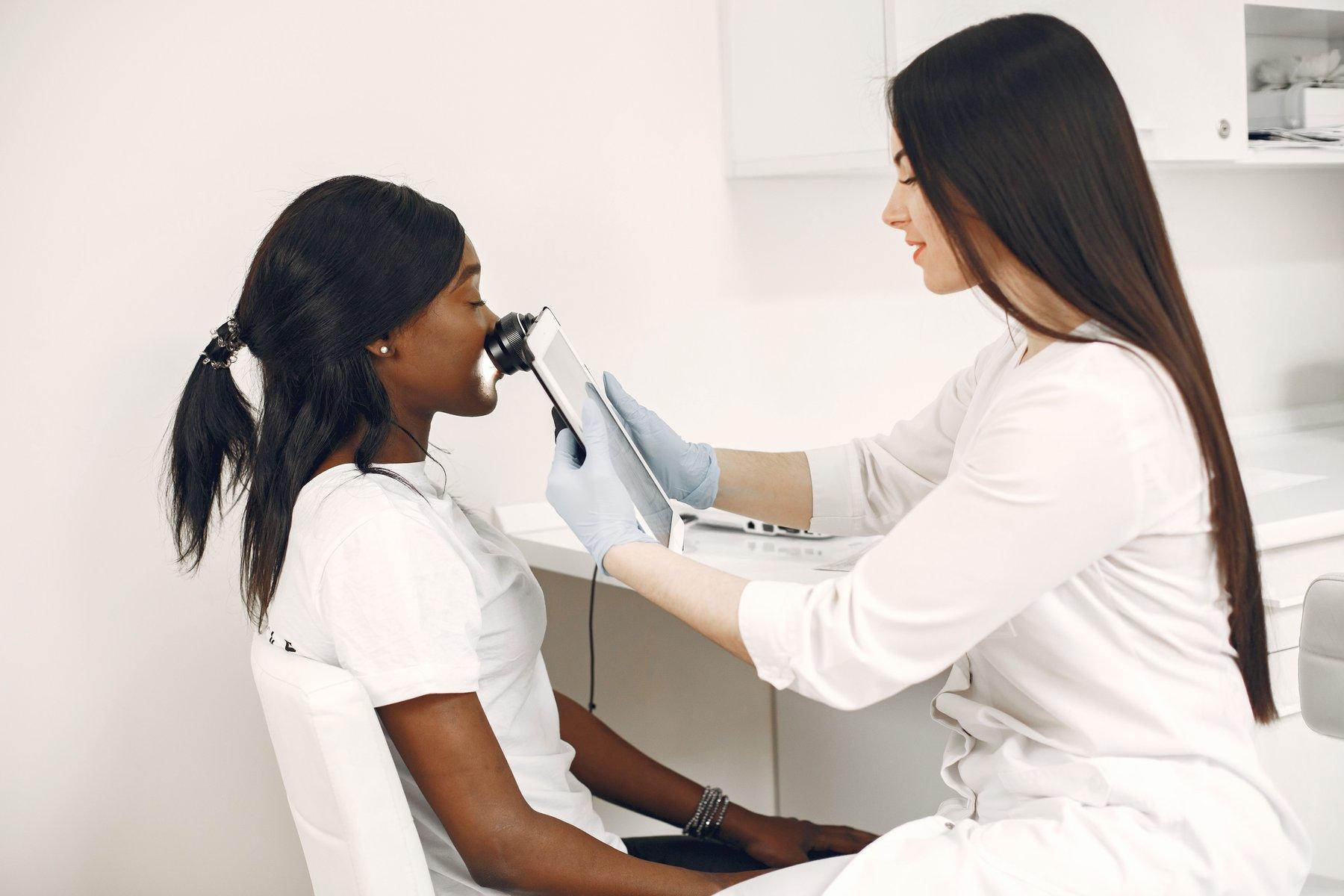
The second form is software, like Perfect Corp's Skincare Pro, built to run on a tablet or smartphone rather than on a dedicated device, and sold to beauty salons, med spas and skincare professionals. Here the price is public but not straightforward: the official product page, checked in November 2026, lists an Essential plan at $139 a month and a Premium plan at $209 a month, both per license rather than per device, while the same page headlines "starting at $199/month" above them, a figure that matches neither of the two plans actually sold below it.
What the independent study on the VISIA camera actually says
A genuinely independent study exists for VISIA, not just material from the manufacturer. Helga Henseler, a plastic surgeon at Klinik am Rhein in Düsseldorf and not a Canfield employee, published it in 2022 in the journal GMS Interdisciplinary Plastic and Reconstructive Surgery DGPW (DOI 10.3205/iprs000169), declaring no conflict of interest, although her clinic is a Canfield customer for a different imaging device, the Vectra XT, advertised on the manufacturer's own site.
The method: eight volunteers photographed, then rephotographed a week later with the face repositioned from scratch. The average differences between the two sessions came out under 2% for texture, sun spots, brown spots and porphyrins, between 2% and 4% for pores and red areas, and around 6% for spots and wrinkles: small numbers, indicating a camera that's consistent with itself.
Consistent with itself isn't the same as accurate. Henseler says so in the conclusions: checking whether the camera actually measures the real condition of the skin, rather than just repeatably, turned out to be very difficult starting from the images alone, and she calls on the manufacturer to run a separate validation on that point. The study is also based on eight people recruited from a single clinic's staff, not a random sample: enough to measure the camera's repeatability, not enough to generalize beyond that clinic. Canfield itself republishes the study as promotional content on its own site, which probably explains how this research came to circulate, improperly, as proof of diagnostic accuracy.
The AI software: a real study, with a different number than the one advertised
A real paper exists for Perfect Corp's software too, not a press release dressed up as science. Cook, Kaszycki, Richardson, Taylor and Feldman published it in 2022 in the Journal of Dermatological Treatment (PMID 36126096), with Steven Feldman, a dermatology professor at Wake Forest School of Medicine, among the authors. The figure published in the paper is 69% agreement between the software and a single dermatologist's judgment, ranging from 53.1% for skin oiliness to 83.7% for redness.
On the same vendor's marketing pages, though, this same study is cited with different, higher numbers: a September 2022 press release cites an internal correlation "above 0.90", the product's current page claims "95% test-retest reliability", and a 2025 post rounds it to "over 90%". None of these three figures matches the published 69%, because they measure different things: the tool's internal consistency, meaning how stable it is repeating a measurement on itself, isn't the same as agreement with an actual dermatologist, but the vendor's material presents them as interchangeable. The 80% figure that circulates on other Perfect Corp pages turns out to come from a different study entirely, based on 46 photographs judged by a single dermatologist, not the one with Feldman, who is in fact listed as a featured partner on that same page: a business relationship visible in the company's own marketing material, which doesn't make the study false but does mean it should be read as a party's own validation, not a neutral measurement.
It's the same pattern seen elsewhere in this series: a single marketing figure, stripped of context, tells a better story than the research behind it actually supports. I wrote about this with an inflated dental treatment-plan case from a vendor's own press release, with the same mechanism at work: whoever sells the tool picks the most favorable number available.
What this means for anyone running a beauty salon
For anyone deciding whether to invest, the two cases tell the same cautionary story from two different angles. The VISIA camera photographs consistently, with an independent study to confirm it, but no one has yet validated whether that consistency amounts to a correct skin diagnosis. Perfect Corp's software has a published independent study too, but the real number it produces, 69% agreement with a single dermatologist, is far from the marketing figures the same vendor publishes elsewhere.
The practical consequence is about what you promise the client, not the technology itself. Anyone running a beauty salon isn't a healthcare professional and can't present the tool's result as a diagnosis: the safest way to use it remains as a visual aid during consultation, to show the skin's condition before proposing a treatment, not as a clinical verdict with a guaranteed accuracy percentage. It's also the cheaper option to test first: the software runs on a tablet you already have and costs, by the official price list, $139 or $209 a month per license, against a far bigger commitment for a dedicated camera.
If you run a beauty salon and want to know how to be found online by people searching for one in your area before evaluating a skin-analysis tool, get in touch: let's talk it through.